
Alliance Global Sreve Anti-Sexual Harassment Policy
I. Introduction
The Alliance Global Serve (“AGS”) is committed to providing an equal gender opportunity and harmonious working, activity, and gathering environment, and ensuring that all members can gather, participate in activities, or work in a safe environment.
II. Position
- AGS complies with the prevailing laws of the Hong Kong Special Administrative Region (HKSAR) concerning anti-sexual discrimination (“the Relevant Laws”) and has formulated this Equal Opportunity Policy to resolutely prevent and eliminate any of the following contravention of the Relevant Laws from occurring within AGS, and to impartially handle all complaints concerning a contravention of the Relevant Laws, including:
- Discrimination
- Harassment
- Vilification
- Please refer to the relevant legislation(s) for the definitions of the above behaviours.
- Complainants have absolute freedom to choose to file a complaint with AGS regarding the above contravention, and may also file a complaint with the relevant law enforcement agency in parallel. However, if a complainant had already filed a complaint with a law enforcement agency which led to criminal investigation being launched, AGS may suspend its internal investigation pending the results of the criminal investigation before resuming its processing of the complaint.
III. Scope of Application
As an employer or service provider, AGS shall fulfill its vicarious responsibilities as imposed by the Relevant Laws and take practicable measures to prevent contravention of the Relevant Laws. Any written complaints will be handled impartially. Inappropriate conduct between participants is not within the scope of this Policy.
IV. Preventive Measures
AGS will provide sexual harassment prevention training to its employees as needed to raise awareness and vigilance.
AGS will encourage mutual respect among employees and foster a positive and healthy workplace culture.
V. Case Inquiry
Any comments may be made with the General Secretary/Deputy General Secretary or the Chairman of the Executive Committee. The making of such comments does not constitute the commencement of a complaint procedure, nor is it within the scope of the Complaint Investigation Committee.
VI. Handling Methods
- Complaint Handling Procedures
- Complaint Time Limit and Method
Complaints concerning a contravention of the Relevant Laws must be signed and submitted to the General Secretary/Deputy General Secretary (or the Chairman of the Executive Committee if the party complained against is the General Secretary/Deputy General Secretary) in writing within 12 months of the incident. AGS will make a final and conclusive decision on whether to initiate an investigation into a delayed complaint, after considering whether the reasons for the delay are fair and reasonable and any potential prejudice that the delay might pose to the party complained against (e.g. feasibility of evidence collection and other difficulties). - Complaint Handling Principles
AGS will handle all complaints and investigations related to the Relevant Laws in accordance with principles of impartiality:- Both parties have the right to know the allegations in a complaint.
- Both parties will respond to the other party’s allegations/refutations fairly.
- All complaint information will be handled confidentially and will not be disclosed to unrelated parties without the written approval of the parties involved.
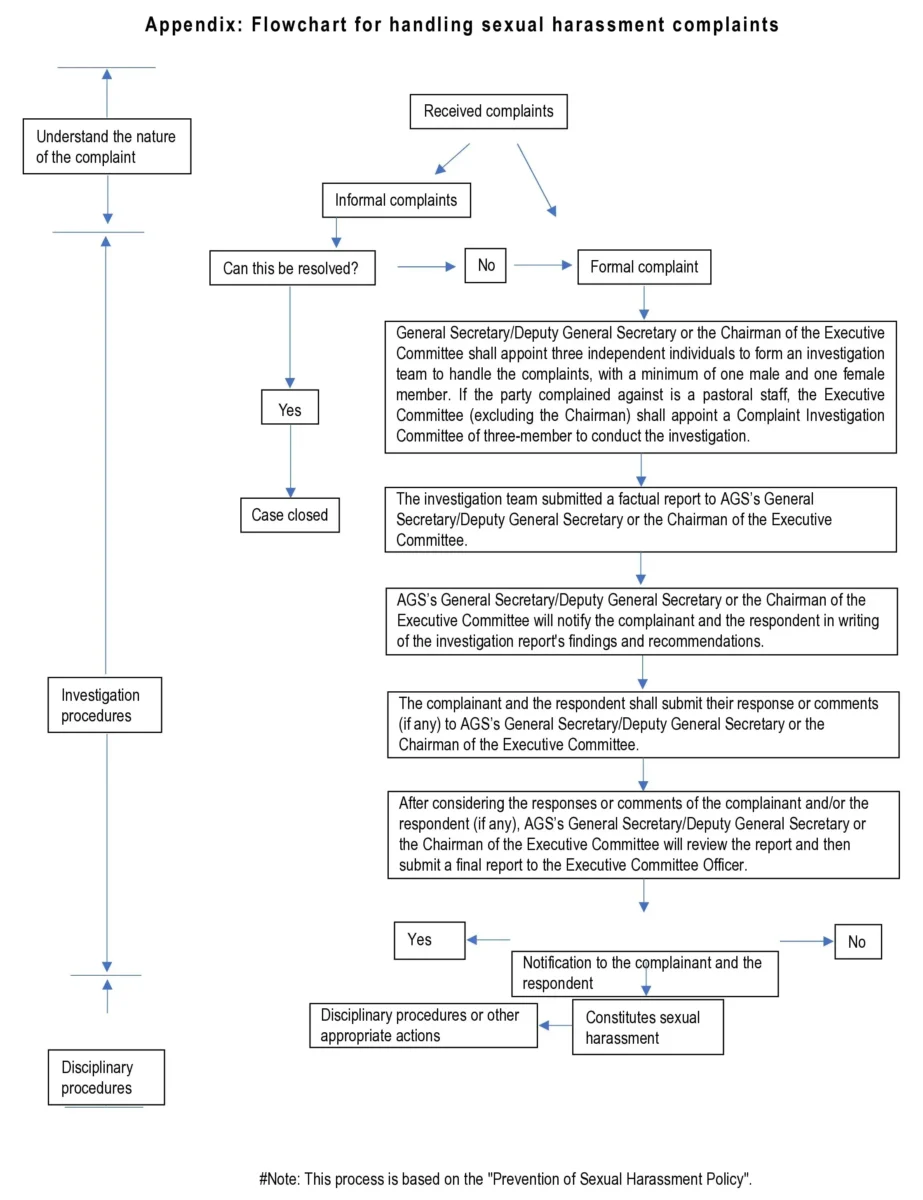
- When the General Secretary/Deputy General Secretary or the Chairman of the Executive Committee decides to initiate an investigation into a complaint, a Complaint Investigation Committee of three suitable individuals (consisting of at least one male and one female) will be appointed to conduct the investigation. A flowchart for handling sexual harassment complaints is attached.
- If the party complained against is a pastoral staff, the Executive Committee (excluding the Chairman) shall appoint a Complaint Investigation Committee of three-member (consisting of at least one male and one female) to conduct the investigation. A flowchart for handling sexual harassment complaints is attached.
- The complainant and party complained against will be informed of the panel members. Any challenges against the independence or impartiality of any of the panel members must be submitted in writing and accompanied with all supporting arguments and documents, for the Association’s final and conclusive decision, to which neither the complainant nor the party complained against may object. The entire complaint investigation must be documented in writing. If needed, with the consent of the complainant, the party complained against and the witness, video recordings may be made during meetings.
- Classification of Investigation Results
Internal investigations by AGS may only result in the followings in accordance to the powers granted by its internal code of conduct:- Allegations fully/partially established
- Allegations not established
- Allegations not substantiated
- The investigation results can only be used for internal disciplinary action imposed according to AGS’s disciplinary code.
- Complaint Time Limit and Method
- Mediation Procedure
- If both sides agree, the complainant and the party complained against may conduct mediation regarding the allegations. The medication is held voluntarily and confidentially. It may be conducted by an independent person. Contents of the mediation meeting cannot be used as evidence in any legal proceedings related to the allegations.
- The terms of the settlement are to be freely determined by both parties, but must not contravene any laws of the HKSAR.
- The settlement agreement is a valid legal contract. In the event of breach of contract, party to the settlement agreement (except the party in breach) may take legal action against the party in breach.
- Inquiry
- Disciplinary Inquiry
- If the Complaint Investigation Committee concludes that the allegations are “fully/partially established,” the Association will consider convening a disciplinary inquiry for further follow-up.
- The Disciplinary Inquiry Tribunal shall consist of no fewer than three suitable persons appointed by AGS.
- AGS cannot directly adopt the investigation report results as evidence in the inquiry; a separate inquiry must be conducted.
- Members of the Complaint Investigation Committee cannot act as members of the Disciplinary Inquiry Tribunal, but may testify as witnesses in the inquiry proceedings if needed.
- Inquiry Procedure
- The procedure shall adhere to principles of “natural justice,” allowing both parties to present evidence, cross-examine and re-examine.
- Disciplinary Inquiry
- Appeal Procedure
- Anyone dissatisfied with the inquiry decision and/or penalty may appeal to the Executive Committee. Such appeal must be submitted in writing within fourteen days of receiving written notice of the penalty.
- The Executive Committee shall appoint three persons to form an Appeal Board, whose members must not have participated in any previous proceedings or decisions.
- The decision of the Appeal Board is final and conclusive. The following are the results of appeals:
- Appeal against Decision
i. Allowed
ii. Upholding the original decision - Appeal against Penalty
i. Mitigation of penalty (a new penalty must be imposed)
ii. Upholding the original penalty
iii. Enhancement of penalty (a new penalty must be imposed)
- Appeal against Decision
VII. This policy document may be amended as needed, and any such amendments must be approved by the Executive Committee.
(This policy on preventing sexual harassment will be formulated in November 2025.)